

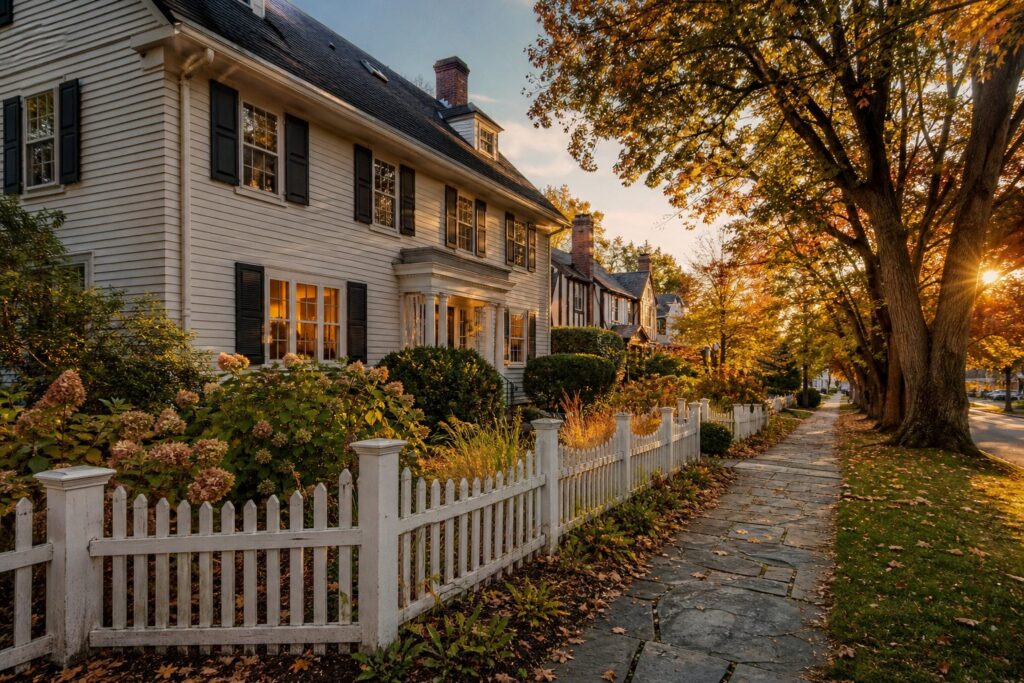
Which Wellesley village is right for you, and how do Wellesley Square, Wellesley Hills, and Wellesley Farms actually compare for today’s buyers?
Wellesley feels less like one town and more like a set of villages, each with its own center, pace, and price profile. Choosing the right one shapes your commute, your weekends, and your long-term investment.
Why This Wellesley Neighborhood Breakdown Matters Right Now
If you are exploring Wellesley in 2026, the first thing you need to understand is that “Wellesley” is not a single experience. It is three distinct villages, each with its own commuter rail station, its own daily rhythm, and its own real estate dynamics. I have spent 26 years helping buyers and sellers navigate the MetroWest Boston market, and what I tell my clients is this: you will feel the difference between these villages within one afternoon of touring.
The market context makes this decision even more consequential. As of September 2026, the Wellesley median sold price sits at $2,150,000 across 203 tracked closings, per Resideline data. The middle half of sales closed between $1,365,000 and $3,050,000. This is not a market where you can afford to buy in the wrong village and course-correct later. Between Q1 2000 and Q3 2025, Wellesley home values increased by 197%, more than double the Consumer Price Index’s 90% growth over the same period, according to Building a Better Wellesley data. Where you buy within Wellesley matters as much as whether you buy in Wellesley at all.
Wellesley Square: The Walkable Heart of Town
Wellesley Square is the closest thing this town has to a proper downtown. If walkability is your top priority, nothing else in Wellesley comes close.
Walk down Central Street on a Saturday morning and you will understand immediately. Wellesley Books, Wasik’s Cheese Shop, Isabel Harvey, Café Mangal, Juniper: these are local institutions, not chain placeholders. Park once on Washington Street and you can now eat your way through three countries before you start the engine. At 555 Washington Street, the former home of Lemon Thai reopened in April 2026 as Charm Ramen & Rice, a nearly 50-seat spot from co-owner Ae Trahan. Fiorella’s Trattoria expanded in place after the Select Board approved a 47-seat addition in December 2025, nearly doubling its indoor seating. Captain Marden’s for seafood and Tutto Italiano for a Saturday pasta run round out the picture.
What You Pay in Wellesley Square
- Single-family homes within walkable distance of the Square typically range from $1.4M to $2.5M or higher, depending on size and condition
- Condos range from roughly $700K to $1.4M
- Historic in-town homes run from $1.6M to $3.5M
- Due to the walkability premium and commuter rail proximity, Wellesley Square carries an above-average price per square foot relative to comparable homes further from center
What You Trade
Smaller lots and more activity close to home. If you want a half-acre buffer and total quiet, the Square is probably not your village. But for buyers relocating from Boston or Cambridge who crave that “I live in a real town” energy, this is the spot.
The Walk Score of 82 out of 100 is the highest in Wellesley. The MBTA Wellesley Square commuter rail station puts Back Bay and South Station between 22 and 40 minutes away. Many streets sit within a 5 to 15 minute walk of the platform, and the nearby Tailby parking lot supports park-and-ride days. You are also adjacent to the Wellesley College campus, with access to Lake Waban, a stunning 100-acre lake perfect for a morning walk.
Wellesley Hills: The Classic Wellesley Experience
Wellesley Hills sits in the central part of town near its own commuter rail station. This is one of the areas people picture when they think of Wellesley: tree-lined streets, well-maintained Colonials and Tudors from the early-to-mid 20th century, and a quiet, established residential character. It has its own small village center, so you get some walkability without being in the middle of town.
What You Pay in Wellesley Hills
The 02481 zip code, which covers Wellesley Hills, shows a median estimated value of $2,463,557 at $770 per square foot, according to RealtyTrac data. The typical range runs from roughly $1.5M to $3M and beyond. This is Wellesley’s largest residential neighborhood, and it is also where some of the town’s most competitive bidding happens. According to MLSPIN data for 2026, Wellesley Hills averages around 93 days on market in higher price tiers, which tells you something important: at the top end, patience matters.
Who Thrives in Wellesley Hills
Families with school-age children consistently gravitate here. Your elementary school will be either Bates or Sprague depending on the specific street. Sprague Elementary holds a GreatSchools rating of 8 out of 10, Wellesley Middle School scores 8 out of 10, and Wellesley High School carries a 9 out of 10 GreatSchools rating with a U.S. News ranking in the top 3% nationally. I always remind buyers that elementary school boundaries matter to families, but every Wellesley student goes on to the same middle and high schools, so obsessing over elementary boundaries can cause you to overlook otherwise great homes.
So what does the Wellesley Hills premium actually get you? Larger lots than the Square, a quieter daily rhythm, and the sense of living in a neighborhood that looks much as it has for decades. New construction has changed some streets here considerably while others remain untouched, and that affects both the feel and how a home is valued over time.
Wellesley Farms: The Quiet, Long-Term Play
Wellesley Farms is quieter and more residential than its two sister villages. Buyers who find a house here near the train often treat it as a long-term home, and I see that pattern consistently in my practice. This is not the village where you pop out for a latte on foot. It is the village where you settle in with serious acreage and stay.
What Makes Wellesley Farms Different
The Wellesley Farms commuter rail station is the third stop on the Worcester Line, giving you the same Back Bay access as the other two villages. But the surrounding streets have a distinctly different character: more space between houses, mature trees, and a residential feel that borders on rural in places. There is no commercial village center to speak of.
Route 9 and Route 16 cut through town, and noise and traffic can change substantially from one street to the next. I always suggest a weekday drive-by before making an offer, because a street that feels serene on a Sunday morning can sound very different at 5 PM on a Tuesday. This advice applies across all three villages but is especially relevant in Wellesley Farms, where the appeal hinges entirely on that sense of peace.
For buyers who want the Wellesley school system, the commuter rail, and the most land their budget can buy, Wellesley Farms deserves a hard look. With 130 five-star reviews from past clients and having closed over 180 transactions, I can tell you that buyers who choose Farms tend to be the ones who have already lived in a more walkable setting and are ready for a different pace.
Beyond the Big Three: Other Wellesley Neighborhoods to Know
You will also hear about neighborhoods that do not have their own commuter rail stations but offer distinct advantages.
- Poets Corner offers homes typically ranging from $1.5M to $2.4M, per local market analysis. For families relocating from Boston or Cambridge who are experiencing sticker shock at Wellesley prices, this is often the neighborhood that makes the numbers work.
- Cliff Estates sits at the top of the market with a median home price of $4.645M, according to local dashboard data, and averages around 103 days on market. The $5M-plus segment recorded 16 closings in 2025, double the 8 in 2024.
- Lower Falls and neighborhoods near the Newton and Needham lines often appeal to buyers who want quick access to Route 95 and a shorter drive into the city.
- Overbrook offers more accessible entry points, with single-family homes starting in the $1.2M to $1.5M range.
Buyers new to the area often underestimate the open space in these neighborhoods. Lake Waban, Morses Pond, Centennial Reserve, and the aqueduct trails are close to many parts of town and dramatically improve daily quality of life.
How to Decide Which Wellesley Village Is Right for You
Here is the framework I use with every buyer I work with. Start with these three questions:
- How do you commute? If you take the train daily, walking distance to a station changes everything. All three villages have one. If you drive to Route 128 or 95, Lower Falls or neighborhoods near the Needham line might serve you better.
- What is your weekend lifestyle? If Saturday morning means walking to coffee and browsing shops, Wellesley Square wins. If it means backyard projects and quiet, Wellesley Farms is your answer. Wellesley Hills splits the difference.
- What is your time horizon? The mid-luxury tier, roughly $2M to $3M, continues to be Wellesley’s most competitive price range, according to local market tracking. If you plan to stay 10-plus years, buying in any village at the right price tends to reward patience.
As a recognized Top 1.5% America’s Best Realtors, a Fast Expert 2026 Top Agent for Needham, Wellesley, and Natick, and a Boston Magazine Top Real Estate Producer for 2025, I bring deep local knowledge to every conversation about which village fits which buyer. The typical annual property tax bill for a median-priced Wellesley home is approximately $19,600, per Slade Mortgage data. When you combine that with typical buyer closing costs of 1.5% to 2.5% of the purchase price, the total financial picture varies meaningfully village to village.
Frequently Asked Questions About Wellesley Neighborhoods
What is the median home price in Wellesley, MA in 2026?
As of September 2026, the median sold price in Wellesley is $2,150,000 across 203 tracked closings, per Resideline data. The middle half of sales closed between $1,365,000 and $3,050,000, and the median sold price per square foot is $668.
Which Wellesley village is the most walkable?
Wellesley Square has a Walk Score of 82 out of 100, the highest in town. Central Street and Washington Street offer independent shops, restaurants, and the commuter rail within a short walk from most surrounding streets.
Does Wellesley have a commuter rail station?
Wellesley has three: Wellesley Square, Wellesley Hills, and Wellesley Farms. All sit on the MBTA Framingham/Worcester Line with service to Back Bay in approximately 22 to 28 minutes. Walking distance to a station significantly affects daily life and property values.
What are property taxes in Wellesley, MA?
For a median-priced home, the typical annual property tax bill is approximately $19,600, per Slade Mortgage calculations. This is a significant carrying cost to factor into your village-by-village comparison.
Which Wellesley neighborhood is most affordable for first-time buyers?
Wellesley Lower Falls, Poets Corner, and Overbrook offer more accessible entry points, with single-family homes starting in the $1.2M to $1.5M range per local market analysis. Condos near Wellesley Square can start below $800K.
How are the schools in Wellesley, MA?
Wellesley High School holds a GreatSchools rating of 9 out of 10 and ranks in the top 3% nationally per U.S. News. Sprague Elementary scores 8 out of 10, and Wellesley Middle School scores 8 out of 10. Every student in town feeds into the same middle and high schools regardless of village.
What is the most expensive neighborhood in Wellesley?
Cliff Estates carries a median home price of $4.645M according to local dashboard data. The $5M-plus segment recorded 16 closings in 2025, double the prior year, showing deepening demand in Wellesley’s ultra-luxury tier.
How fast do homes sell in Wellesley in 2026?
Homes are going to pending in around 11 days on average, per local market tracking. However, properly priced homes that attract the right buyers receive offers even faster. Listings that miss on price tend to linger, with expired listings averaging 123 days on market.
Is Wellesley a good long-term investment?
Between Q1 2000 and Q3 2025, Wellesley home values increased by 197%, more than double the 90% growth in the Consumer Price Index over the same period, according to Building a Better Wellesley data. The town is fully built out with no mechanism to meaningfully increase housing supply.
Should I worry about traffic noise in certain Wellesley neighborhoods?
Yes. Route 9 and Route 16 cut through town, and noise levels can change dramatically from one street to the next. I always suggest a weekday drive-by before making an offer, because what feels peaceful on a Sunday morning can sound very different during rush hour.
The Bottom Line on Choosing Your Wellesley Village
You are not just buying a house in Wellesley. You are choosing a village, a daily rhythm, and a long-term investment. Wellesley Square gives you walkability and energy. Wellesley Hills gives you the classic, established Wellesley feel. Wellesley Farms gives you space and quiet. And neighborhoods like Poets Corner, Lower Falls, and Overbrook offer entry points that might surprise you.
With 26 years of MetroWest Boston real estate experience and deep roots in the Wellesley and Needham communities, I help buyers match their lifestyle to the right village, not just the right house. If you are ready to see the difference for yourself, call me at (781) 223-5641. One afternoon of touring with someone who knows every street will make your decision clear.

Jane & Jonathan Migdol · Gibson Sotheby's International Realty
Global Real Estate Advisors — MetroWest Boston
Get in touch →