

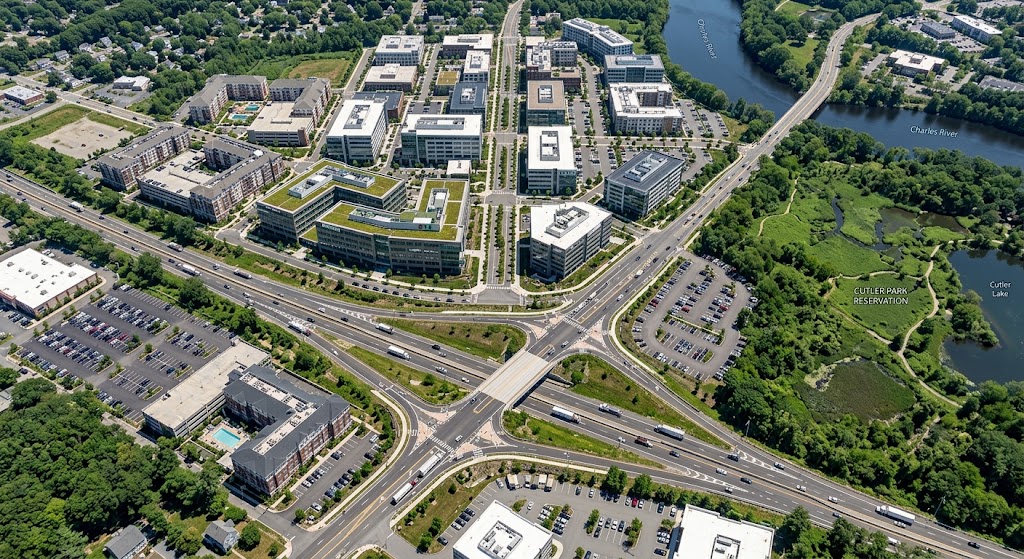
How Needham Crossing’s Commercial Tax Base Saves Every Needham Homeowner Nearly $2,000
How does Needham‘s split tax rate benefit residential homeowners, and what role does Needham Crossing play in keeping your property taxes lower?
Needham’s commercial sector pays close to 23% of total taxes while representing only 13.1% of taxable value, saving the average homeowner $1,962 per year through the town’s deliberate split tax rate policy.
Why This Tax Structure Matters for Needham Homeowners Right Now
Here is something I tell nearly every client, and it still surprises most of them: your Needham tax bill is being directly subsidized by the commercial sector, and it is a meaningful number. The average single-family tax bill in Needham increased 7.52% in 2026, the largest annual percentage jump since 2020. That increase was driven primarily by residential property values growing faster than commercial values, which shifted more of the levy burden onto homeowners.
What does that actually mean for you? It means the health of Needham Crossing and the broader commercial corridor is not some abstract municipal planning topic. It is the single biggest factor determining whether your quarterly tax payment goes up $300 or $800. With 26 years of experience helping Needham families buy and sell homes, I have watched this dynamic play out in real time across multiple market cycles. And in my experience, the homeowners who understand this relationship make better long-term decisions about where and when to buy, sell, or hold.
How Needham’s Split Tax Rate Works and What It Means for Your Wallet
You might have heard the term “split tax rate” without fully understanding the mechanics. Let me break it down plainly.
Needham’s Select Board, in consultation with the Board of Assessors, votes annually to set what is called a “shift factor.” For fiscal year 2025, they voted to set that shift factor at 1.75, the maximum shift available for the town. This is not accidental. It is a deliberate policy choice that has been renewed every single year since the two-tier tax system was implemented in 1988.
What the Numbers Actually Look Like
- Residential tax rate (FY2026): $10.83 per $1,000 of valuation
- Commercial and industrial rate: Nearly double the residential rate
- Average single-family tax bill: $16,690 per year
- Your annual savings from the split rate: $1,962
So if Needham taxed all property at a single flat rate, your tax bill would be nearly $2,000 higher every year. Over a decade of homeownership, that is close to $20,000 in savings that most homeowners never even realize they are receiving.
One couple I worked with was inheriting a colonial near Needham Center and debating whether to keep it as a rental or sell. When I walked them through the split rate and how it kept their carrying costs lower than a comparable property in a town without this structure, it changed their entire calculation. They decided to hold the property, and the math worked precisely because of this commercial subsidy.
Why Needham Crossing Is the Financial Engine Behind Your Property Tax Savings
If you are a Needham homeowner, you owe a quiet debt of gratitude to Needham Crossing. The former New England Business Center, re-zoned in 2002 and again in 2011, was rechristened as Needham Crossing for good reason. It is not just an employment hub. It is a financial lifeline for every residential taxpayer in town.
Here is the critical ratio to understand: commercial, industrial, and personal property represents approximately 13.1% of Needham’s total taxable value but pays close to 23% of total taxes collected. That means the commercial sector contributes nearly twice its proportional share to the town’s $192.4 million total tax levy.
Every major employer that locates or expands in Needham Crossing is effectively subsidizing the school system, the fire department, road maintenance, the Rosemary Recreation Complex, and every other municipal service that makes this town desirable. The town has been proactive about protecting this asset, taking deliberate rezoning steps to ensure the commercial base remains healthy and growing.
What I always explain to buyers considering Needham is this: you are not just buying a house near Volante Farms and Greene’s Field. You are buying into a town that has structurally engineered its own desirability through four decades of smart municipal policy. That is not luck. That is intentional governance.
How the Commercial Tax Base Funds Needham’s Top-Ranked Schools
The connection between Needham Crossing’s tax contributions and Needham’s schools and their role in driving property values is not a coincidence. It is a direct financial pipeline.
Needham Public Schools serves approximately 5,200 students across five elementary schools, Pollard Middle School, and Needham High School. The school system consistently earns top-tier rankings, with Needham High posting a 98.3% four-year graduation rate and MCAS proficiency rates well above state averages. William Mitchell Elementary holds a 9.3 out of 10 rating with 95% ELA proficiency.
The reason Needham can fund this caliber of education without crushing residential taxpayers is precisely because Needham Crossing and the commercial corridor carry a disproportionate share of the levy. The town’s total property tax revenue is projected to grow from $192.4 million to $201.7 million, with much of that increase flowing directly back into schools and services.
Having closed over 180 transactions in the MetroWest Boston area, I can tell you that school quality is the number one driver of residential demand in Needham. And the split tax rate is the number one reason schools can maintain that quality without pushing residential taxes to unsustainable levels. These are not separate conversations.
What Probate and Inherited Property Sellers in Needham Need to Know About This Tax Structure
If you have inherited a home in Needham, the split tax rate has direct implications for your estate planning and selling timeline.
Carrying Costs Are Real, but Lower Than You Think
With the average single-family tax bill at $16,690, holding an inherited property during probate is not cheap. But that bill is nearly $2,000 per year lower than it would be without the commercial subsidy. Over a 12 to 18 month Massachusetts probate timeline, that split rate is saving heirs between $2,000 and $3,000 in carrying costs.
The Teardown Dynamic Matters for Your Property’s Value
Here is something most probate sellers do not realize: when a home valued at $1 million is torn down and replaced by a home valued at $2 million, that adds $1 million to the town’s tax base. At the current rate of $10.83 per thousand, a single teardown generates over $10,000 in new annual tax revenue. Many inherited homes in Needham are older colonials or mid-century capes that builders actively seek as teardown candidates, meaning the land value’s impact on property prices can be substantial.
A family I recently helped was managing an estate near Needham Heights with a 1960s cape that needed extensive work. Rather than pouring money into renovations, we positioned the property as a teardown opportunity. The lot sold at a premium because builders understood the underlying value of Needham’s tax structure and school system. The family netted significantly more than they would have after a costly renovation.
Your Inherited Property Still Benefits from the Split Rate
Whether you plan to sell, rent, or occupy an inherited Needham home, the commercial tax subsidy continues working in your favor every quarter. With the median single-family sale price at $2,359,500 and 38% of homes selling over asking price, the Needham market remains exceptionally strong for sellers.
The Warning Signs Every Needham Homeowner Should Watch
This benefit is not guaranteed forever. The 7.52% tax bill increase in 2026 happened because residential property values surged (average assessments jumped 22.28% to $1,464,398) while commercial values did not keep pace. When the commercial base shrinks relative to residential value, homeowners absorb more of the levy.
That is exactly why the ongoing revitalization of Needham Crossing is so important. The town’s 9,672 residential properties, cumulatively valued at $14.745 billion, depend on a healthy commercial corridor to share the tax burden. Maintaining that balance is not just a municipal planning issue. It is a household budget issue for every single homeowner in town.
Frequently Asked Questions
What is Needham’s current residential tax rate?
The FY2026 residential tax rate in Needham, MA is $10.83 per $1,000 of valuation. The commercial rate is nearly double that amount. This split rate has been in place since 1988, and the Select Board votes annually to maintain the maximum allowable shift, consistently prioritizing residential taxpayers across every administration and economic cycle.
How much does the split tax rate save the average Needham homeowner?
The split tax rate represents a $1,962 annual savings for the average residential property owner. Over a decade of homeownership, that translates to nearly $20,000 in cumulative savings. This is a direct financial benefit that most homeowners have never been told about and that rarely comes up during the purchase conversation.
What is Needham Crossing and why does it matter to homeowners?
Needham Crossing is the former New England Business Center, re-zoned in 2002 and again in 2011. It serves as a vital component of Needham’s ability to maintain quality services and broaden the tax base. Every employer that locates or expands there effectively subsidizes residential tax rates, school funding, and municipal infrastructure.
How does the commercial sector’s tax contribution break down in Needham?
Commercial, industrial, and personal property represents approximately 13.1% of Needham’s total taxable value but pays close to 23% of total taxes collected. The total tax levy for fiscal year 2025 is $192.4 million, meaning the commercial sector’s disproportionate contribution amounts to tens of millions of dollars in residential tax relief annually.
Why did Needham’s tax bills increase 7.52% in 2026?
The increase was driven by a state-required five-year recertification process that revealed residential assessments had not kept pace with actual market appreciation. The average single-family home value increased 22.28% to $1,464,398 in a single assessment year, pushing more of the levy onto residential taxpayers. This underscores why maintaining a strong commercial base is essential.
How does Needham’s tax structure support its school system?
Needham Public Schools, which ranks among the top systems in Massachusetts, is funded significantly by the commercial tax base. Needham High School ranks 21st out of 349 Massachusetts high schools with a 98.3% graduation rate. The commercial sector’s disproportionate tax contribution allows the town to fund this level of education without overburdening residential taxpayers.
What happens if Needham’s commercial tax base weakens?
When commercial property values decline relative to residential values, homeowners absorb a larger share of the total tax levy. The 2026 tax increase demonstrated this directly. Town leadership has taken deliberate steps, including multiple rezonings of the Needham Crossing area, to prevent this outcome and protect residential taxpayers.
How does the split tax rate affect inherited property in Needham?
Inherited properties benefit from the same commercial tax subsidy as all residential properties. During the 12 to 18 month Massachusetts probate timeline, the $1,962 annual savings reduces carrying costs meaningfully. For heirs weighing whether to hold or sell, the lower effective tax rate can influence the financial analysis significantly.
What is the average property tax bill for a Needham single-family home?
The average single-family tax bill in Needham for FY2026 is $16,690, up from $15,523 the prior year. That increase equals roughly $292 per quarter. Without the split rate, the average bill would be approximately $18,652, making the commercial subsidy one of the most significant household financial benefits in town.
Is Needham’s split tax rate likely to continue?
The split tax rate has been in place since 1988 and has survived multiple administrations, economic cycles, and policy reviews. The Select Board consistently votes for the maximum allowable shift factor of 1.75. While no tax policy is permanently guaranteed, nearly four decades of continuity suggests strong institutional commitment to maintaining this residential benefit.
The Bottom Line
Understanding Needham’s split tax rate is not just a municipal trivia exercise. It is one of the most important, and most overlooked, financial advantages of owning property in this town. The $1,962 annual savings, the connection between Needham Crossing’s commercial vitality and your school system’s quality, and the deliberate policy choices that have protected residential taxpayers since 1988 all contribute to why Needham remains one of the strongest long-term real estate holds in MetroWest Boston.
Whether you are a current homeowner, a buyer evaluating Needham neighborhoods, or an heir navigating a probate sale, this tax structure should be part of your decision-making framework. With 130 five-star reviews and over 26 years helping families in this community, I have seen firsthand how understanding these details changes outcomes. If you want to talk through what the split tax rate means for your specific situation, I am always happy to walk you through the numbers. Reach me at (781) 223-5641 or email me at Jane.migdol@gibsonsir.com.

Jane & Jonathan Migdol · Gibson Sotheby's International Realty
Global Real Estate Advisors — MetroWest Boston
Get in touch →