

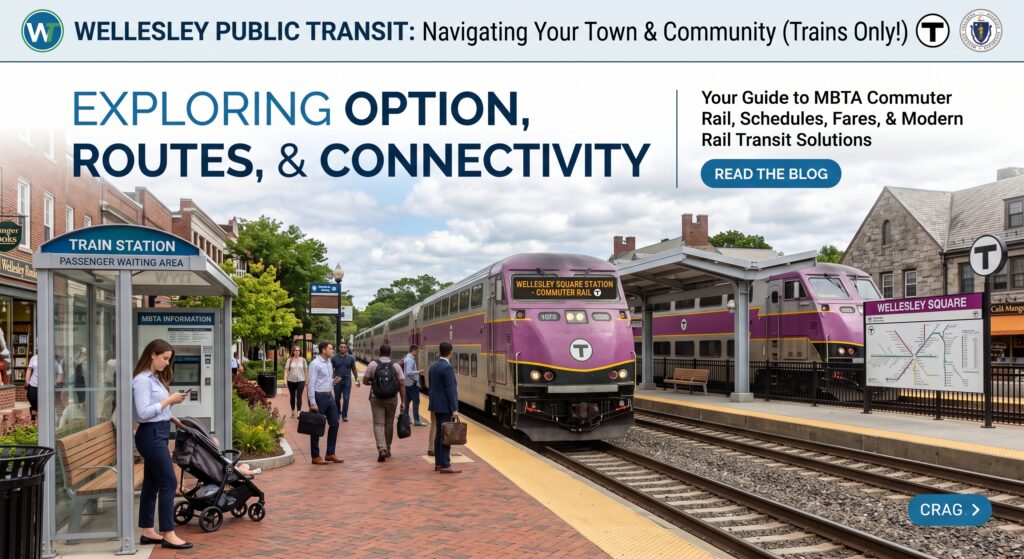
Wellesley’s Commuter Advantage: Rail, Highway, and the Boston Connection A practical guide to commuting from Wellesley
What makes Wellesley one of the best-connected suburbs for getting into Boston, and how does its transit infrastructure actually compare to neighboring towns?
Wellesley offers three commuter rail stations on the MBTA Framingham/Worcester Line, direct Route 9 access to Boston, and I-95/Route 128 highway connectivity, making it arguably one of the most transit-rich suburbs in MetroWest Boston](https://janemigdol.realscout.com/homesearch/shared-searches/U2hhcmVhYmxlU2VhcmNoTGluay0yMTQ2MQ==).
Why Wellesley’s Transit Advantage Matters Right Now
If you’re considering a move from Needham or another MetroWest community into Wellesley, the transit conversation deserves more attention than it typically gets. Wellesley is one of the most transit-rich suburbs in Greater Boston, and most buyers do not realize the full picture until they dig into it.
In my 26 years of working with buyers and sellers across MetroWest Boston, I consistently see the commute question become the deciding factor, particularly for downsizers and 55+ homeowners weighing whether they can comfortably go from two cars to one. Wellesley’s combination of three commuter rail stations, Route 9 running directly into Boston, and immediate I-95/Route 128 access creates a level of flexibility that no single neighboring town fully replicates. For those of you exploring a lifestyle transition, that flexibility translates into real daily freedom, whether you’re heading to a medical appointment at Longwood, meeting friends in the Back Bay, or visiting family across the metro.
As of fall 2026, the MBTA has extended fare promotions that make this conversation even more compelling. But before we talk cost, let me walk you through what Wellesley actually puts at your doorstep.
Three Commuter Rail Stations in Wellesley: What Each One Offers
Three commuter rail stations in one town is rare, and it is a meaningful quality-of-life advantage that shapes how you experience daily life in Wellesley. All three stations sit on the MBTA Framingham/Worcester Line, confirmed active on the current fall 2026 schedule, per MBTA service data as of September 2026.
Wellesley Square Station
This is the most walkable of the three, serving the heart of Wellesley’s town center. If you prioritize the ability to walk to the train, grab coffee, and board without needing a car at all, Wellesley Square is the station that draws the most interest. One honest note: as of September 2026, Wellesley Square does not yet have a fully accessible path connecting the inbound and outbound platforms, per MBTA station data. Designs for a compliant pathway are underway. If accessibility is a consideration for you or a family member, this is worth verifying before you commit to a neighborhood around this station.
Wellesley Hills Station
Wellesley Hills serves the Linden Square corridor and offers easier parking with a slightly less crowded platform. For those of you who plan to drive a few minutes to the station and prefer a relaxed boarding experience, this is often the sweet spot.
Wellesley Farms Station
The quietest and most suburban of the three, Wellesley Farms is preferred by buyers who value calm over proximity to town amenities. Note that as of September 2026, Wellesley Farms has a track-change advisory in effect: outbound trains are currently boarding from the inbound platform through 8:00 PM, per MBTA construction alerts. This is part of ongoing track work, not a permanent arrangement.
What does this three-station layout actually mean for you? It means most Wellesley neighborhoods are within a short drive, or even a walk, of commuter rail access. That is something no neighboring town fully replicates.
The Framingham/Worcester Line to Boston: Where It Takes You in Wellesley
The Framingham/Worcester Line runs inbound from all three Wellesley stations to two of Boston’s most central transit hubs: Back Bay Station and South Station. Back Bay connects you to the Orange Line and Amtrak. South Station connects to the Red Line, Silver Line, and Amtrak. For those of you who need to reach different parts of Boston on different days, having both endpoints is a genuine advantage.
In my experience advising clients on this commute, the approximately 25-minute express ride from Wellesley to Back Bay is one of the town’s most compelling selling points. That commute is competitive with, and in my experience often faster than, driving from closer-in suburbs during peak hours. Even if you’re past the daily office commute stage, that 25-minute connection to Back Bay puts you within easy reach of the theater district, the South End, and every major medical facility along the Longwood corridor.
Current Schedule and Construction Context
A new Framingham/Worcester Line construction schedule took effect September 18, 2026, per MBTA alerts. Specific departure times from all three Wellesley stations may have shifted. If you are evaluating a move right now, I always recommend checking the current MBTA timetable directly before planning trial commutes. The construction reflects ongoing track work; for the latest on service impacts, I recommend checking MBTA alerts directly.
Fall 2026 Fare Promotions Worth Knowing About
The MBTA extended its summer 2026 fare promotions into fall 2026, per MBTA fare data. Monthly passes remain at 50% off, and $1 companion rides continue on weekends. There is also a $10 Weekend Pass that provides unlimited travel across all lines and zones. Wellesley stations fall within Zone 3 on the MBTA fare structure. The general commuter rail fare range runs from $2.40 to $13.25 one-way depending on zone, with monthly passes ranging from $90.00 to $426.00 across all zones, per the MBTA commuter rail fare guide as of September 2026. For exact Zone 3 pricing, the MBTA fare zone page has the specifics.
For downsizers considering whether Wellesley lets you drop a second car, the math becomes very favorable when you factor in the current promotional pricing on that Weekend Pass. A $10 day for unlimited Boston access is hard to beat.
Route 9, I-95, and the Green Line: Wellesley’s Highway and Beyond-Rail Connections
Rail is only part of the picture. What I tell my clients is that Wellesley sits at a genuine crossroads that gives you multiple ways to reach multiple destinations, and each route serves a different purpose in your life.
Route 9 Direct to Boston
Route 9 runs directly from Wellesley through Brookline into the Fenway and Longwood Medical Area. If you have regular appointments at Brigham and Women’s, Dana-Farber, Beth Israel Deaconess, or any of the major hospitals clustered along that corridor, Wellesley is one of the most direct suburban connections available. Hospital and university employees who assume they need to live in Brookline or Jamaica Plain routinely discover that Wellesley is a practical alternative.
I-95/Route 128 Employment Corridor
Wellesley sits directly on I-95/Route 128, giving you easy access to the suburban employment corridor stretching from Burlington to Waltham to Needham. If you are consulting part-time, serving on boards, or simply visiting family in different parts of the suburbs, this highway access means you are not choosing between suburban convenience and city connectivity. You have both.
Green Line D Branch Proximity
Here is a dimension most buyers overlook entirely. In my experience, eastern Wellesley neighborhoods provide practical access to the Green Line D Branch at Woodland and Waban stations in Newton. This gives you a direct connection to Fenway, Kenmore, Copley, and Boylston without a commuter rail ticket. For those of you with occasional rather than daily Boston trips, this access point provides meaningful convenience. A concert at Symphony Hall, a Red Sox game, a gallery opening: you can reach all of it through the Green Line without needing to plan around a commuter rail schedule.
How Wellesley’s Transit Compares to Needham, Newton, and Natick
If you are weighing Wellesley against neighboring towns, which many of my clients do, particularly those moving from Needham, here is how the transit profiles actually compare.
- Wellesley: Three Framingham/Worcester Line commuter rail stations, Route 9 direct to Longwood and Boston, I-95/Route 128 access, and Green Line D Branch proximity via Newton. A broad multi-modal transit profile that is difficult to match among MetroWest suburbs.
- Needham: Served by the Needham Branch commuter rail line (a separate MBTA line from the Framingham/Worcester Line; the two do not share stations).
- Newton: Offers Green Line D Branch access in several neighborhoods but has fewer commuter rail options in key areas. Newton is larger geographically, so transit access varies widely depending on which village you live in.
- Natick: Has commuter rail service on the same Framingham/Worcester Line but sits further from Boston by both rail and road. Natick Center Station is currently undergoing accessibility upgrades, per MBTA commuter rail data as of September 2026.
One important clarification: the Needham Branch commuter rail line serves Needham, not Wellesley. The two lines are distinct. If you are moving from Needham to Wellesley, you are switching from the Needham Branch to the Framingham/Worcester Line, which changes your inbound route and station options entirely.
Having closed over 180 transactions and earned a 5 out of 5 star rating across 130 client reviews, I have helped many families navigate exactly this comparison. The transit conversation is often where Wellesley buyers make their final decision.
Hybrid Work, Downsizing, and the Real Value of Wellesley’s Transit Flexibility
The shift to hybrid work has changed the commuter rail conversation from daily necessity to strategic flexibility, and Wellesley benefits either way. If you commute two or three days a week, the approximately 25-minute Back Bay train is an easy lift on required office days. If you work remotely full-time or are retired, you value the optionality: knowing the train is there when you need it, without being dependent on it daily.
For downsizers and 55+ homeowners specifically, this matters in a very concrete way. Transit access directly affects whether you can comfortably go from two cars to one. In Wellesley, the answer is often yes. Between the commuter rail, Route 9, and the Green Line D Branch proximity, you have genuine alternatives to driving for most of your regular Boston-bound trips.
Even the Boston Marathon weaves through Wellesley near the Framingham/Worcester Line stations, with roads temporarily closed near the stations on Marathon Monday, per MBTA marathon guidance. It is a small detail, but it shows how deeply the rail infrastructure is embedded in Wellesley’s civic geography. This is a town that lives alongside its transit, not in spite of it.
Frequently Asked Questions About Commuting from Wellesley
How many commuter rail stations does Wellesley have?
Wellesley has three active commuter rail stations on the MBTA Framingham/Worcester Line: Wellesley Square, Wellesley Hills, and Wellesley Farms. All three are confirmed active stops on the fall 2026 schedule, per MBTA service data. Having three stations distributed across town means most Wellesley neighborhoods are within a short drive or walk of commuter rail access.
What commuter rail line serves Wellesley?
Wellesley is served exclusively by the MBTA Framingham/Worcester Line. This is a different line from the Needham Branch, which serves Needham. The two lines do not share stations. The Framingham/Worcester Line runs inbound to Back Bay and South Station in Boston.
How long is the commuter rail ride from Wellesley to Boston?
In my experience advising clients on this commute, express trains on the Framingham/Worcester Line from Wellesley to Back Bay run in approximately 25 minutes — a figure based on local commuting experience, not a published timetable. This is competitive with, and in my experience often faster than, driving from closer-in suburbs during peak hours.
Is Wellesley Square Station accessible?
As of September 2026, Wellesley Square Station does not have a fully accessible path connecting the inbound and outbound platforms, per MBTA station data. Designs for a compliant accessible pathway are underway. If mobility is a consideration, you should verify current conditions before choosing a neighborhood near this station.
What fare zone is Wellesley in for commuter rail?
Wellesley stations are in Zone 3 on the MBTA commuter rail fare structure. The MBTA’s overall commuter rail fares range from $2.40 to $13.25 one-way and $90.00 to $426.00 for monthly passes across all zones, per MBTA fare data as of September 2026.
Are there any commuter rail fare discounts available in fall 2026?
Yes. The MBTA extended summer 2026 fare promotions into fall 2026, per MBTA fare data. Monthly passes are at 50% off, $1 companion rides are available on weekends, and a $10 Weekend Pass provides unlimited travel across all lines and zones.
Can you reach the Green Line from Wellesley?
Eastern Wellesley neighborhoods provide access to the Green Line D Branch at Woodland and Waban stations in Newton. This gives you a direct connection to Fenway, Kenmore, Copley, and Boylston without requiring a commuter rail ticket. It is particularly useful for occasional trips rather than daily commutes.
How does Wellesley compare to Needham for commuting to Boston?
Needham is served by the Needham Branch commuter rail line but lacks Green Line proximity and a comparably direct route to the Longwood Medical Area. Wellesley offers three Framingham/Worcester Line stations, Route 9, I-95/Route 128, and Green Line D Branch proximity, giving it a broader multi-modal transit profile.
Is Route 9 a practical commute route from Wellesley?
Route 9 runs directly from Wellesley through Brookline into the Fenway and Longwood Medical Area in Boston. For professionals employed at the medical and academic institutions along that corridor, it is one of the most direct suburban-to-city routes available.
Does Wellesley have highway access to the Route 128 employment corridor?
Yes. Wellesley sits directly on I-95/Route 128, providing access to the major tech, biotech, and professional employment corridor stretching from Burlington to Needham. You are not choosing between suburban living and employment access; Wellesley is central to both.
The Bottom Line
Wellesley’s transit infrastructure is genuinely exceptional for a town of its size and character. For downsizers and 55+ homeowners weighing whether you can reduce to one car, or simply want the freedom to reach Boston on your own terms, Wellesley delivers that flexibility in practice, not just on paper.
As a Needham-based Realtor with 26 years of experience and recognition as a Top 1.5% America’s Best Realtors honoree and 2026 Fast Expert Top Agent for Needham, Wellesley, and Natick, I help clients navigate exactly this kind of decision every day. If you are evaluating a move to Wellesley and want to understand how the commute would actually work for your life, I would welcome the conversation. Reach me at (781) 223-5641.

Jane & Jonathan Migdol · Gibson Sotheby's International Realty
Global Real Estate Advisors — MetroWest Boston
Get in touch →